Selecting the correct weld type is a critical decision that directly impacts project integrity, material strength, and overall cost efficiency. Each welding process offers distinct advantages and limitations, making a universal "best" option non-existent. The optimal choice depends on specific factors: the base metal type, material thickness, desired joint quality, required production speed, operational environment, and the welder's skill level. Understanding these variables upfront guides the selection of equipment, consumables, and techniques, ensuring the final product meets performance specifications and budget constraints.
Understanding Core Weld Types and Their Applications
Shielded Metal Arc Welding (SMAW) / Stick Welding
SMAW, commonly known as stick welding, utilizes a consumable electrode coated in flux. The electric arc melts the electrode and base metal, with the flux creating a shielding gas and slag to protect the weld pool from atmospheric contamination. This process is noted for its simplicity and portability, requiring minimal auxiliary equipment beyond the power source and electrodes.
Common Uses: Heavy fabrication, field repairs, structural steel, maintenance, and repair in less-than-ideal conditions (e.g., dirty or rusty surfaces). It is particularly effective for thick materials and outdoor applications.
Key Specs:
- Amperage Range: Typically 40-300 amps, depending on electrode size and type.
- Electrode Sizes: Ranging from 1/16 inch to 5/16 inch diameter.
- Material Compatibility: Carbon steel, stainless steel, cast iron, and some non-ferrous metals.
Buying Tips: Consider inverter-based machines for lighter weight and better arc control. Match electrode types (e.g., E6010 for deep penetration, E7018 for high strength) to your primary applications. Ensure the power source provides stable arc characteristics for consistent results.
Best for: Outdoor repairs, thick materials, dirty or rusty surfaces, cost-effective general-purpose welding.
Gas Metal Arc Welding (GMAW) / MIG Welding
MIG welding employs a continuously fed wire electrode, which melts into the weld pool under a shield of inert or semi-inert gas. This process is favored for its speed, relative ease of learning, and clean welds, making it suitable for both production environments and hobbyist use.
Common Uses: Automotive body repair, light to medium fabrication, manufacturing, general repair, and DIY projects. It excels in repetitive welding tasks and on thinner gauge metals.
Key Specs:
- Wire Diameter: Common sizes include 0.023, 0.030, 0.035, and 0.045 inches.
- Shielding Gas: 100% CO2 for cost-effectiveness and deep penetration, or Argon/CO2 mixes (e.g., 75% Ar/25% CO2) for smoother arcs and less spatter.
- Voltage/Amperage: Coordinated settings based on wire speed, typically 15-30 volts and 50-300 amps.
Buying Tips: Look for machines with adjustable voltage and wire feed speed. Consider a spool gun accessory if planning to weld aluminum. Evaluate duty cycle for continuous operation needs. Inverter-based MIG welders offer more control and efficiency.
Best for: Production welding, thin gauge metals, beginners, high-speed fabrication.
Gas Tungsten Arc Welding (GTAW) / TIG Welding
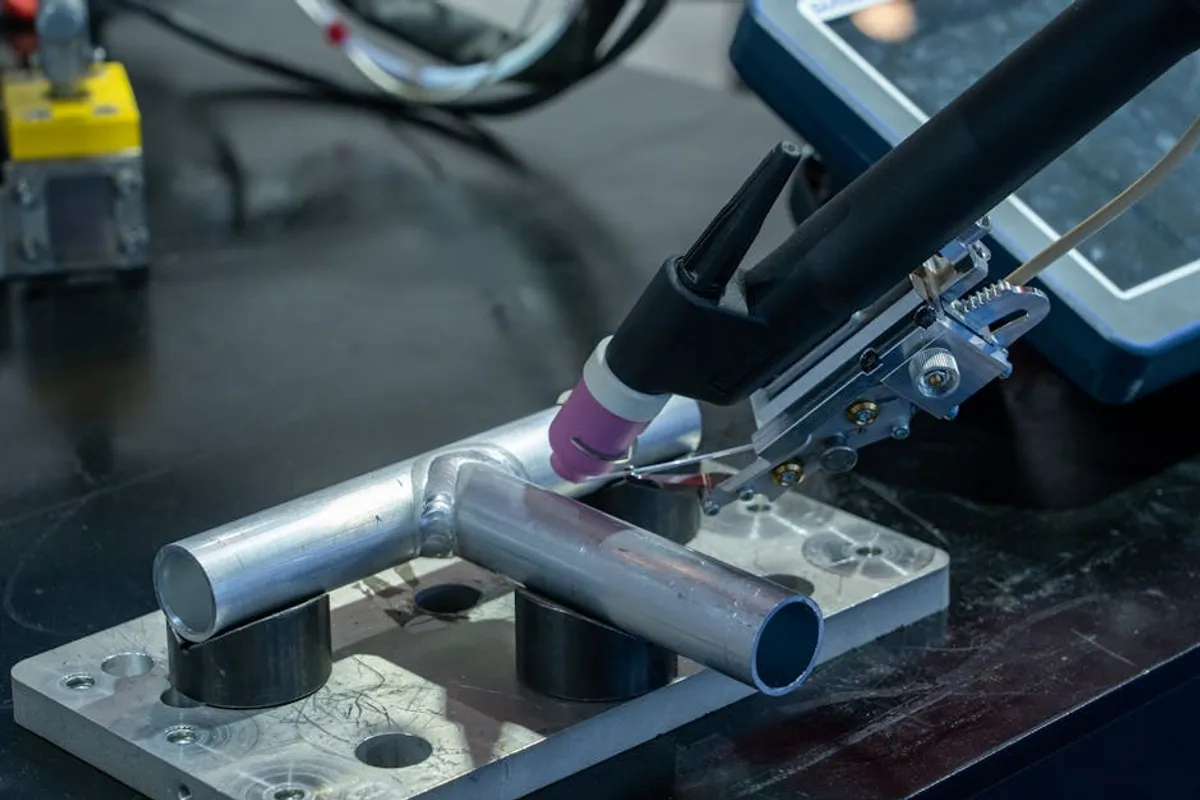
TIG welding uses a non-consumable tungsten electrode to create the arc, with a separate filler rod manually fed into the weld pool and an inert gas (typically argon) providing shielding. This process offers precise control, producing high-quality, aesthetically pleasing welds with minimal spatter.
Common Uses: Aerospace, medical equipment, pressure vessels, exotic metals (titanium, magnesium), thin gauge materials, and applications requiring superior weld appearance. It is ideal for critical, high-integrity joints.
Key Specs:
- Tungsten Types: Ceriated (non-radioactive, good for AC/DC), Lanthanated (general purpose, good arc stability), Thoriated (radioactive, excellent arc starting, being phased out).
- AC/DC Capability: DC for steel, stainless steel, copper; AC for aluminum and magnesium.
- Pulse Function: Improves control over heat input, reduces distortion, and enhances penetration.
Buying Tips: Prioritize high-frequency arc starting for non-contact starts. A foot pedal control is essential for precise amperage modulation. Consider water cooling for high-amperage, continuous TIG welding to protect the torch.
Best for: Critical applications, dissimilar metals, thin materials, aesthetic finishes, precision work.
Flux-Cored Arc Welding (FCAW) / Flux-Core Welding
FCAW uses a tubular wire filled with flux, which provides shielding gas and slag protection. It can be self-shielded (no external gas required) or gas-shielded (requires external gas). This process is known for its high deposition rates and deep penetration, especially on thicker materials.
Common Uses: Heavy fabrication, structural steel erection, outdoor welding, and applications where material surfaces may be less than perfectly clean. It is a robust process for demanding environments.
Key Specs:
- Wire Diameter: Commonly 0.030 to 0.062 inches.
- Self-Shielded vs. Gas-Shielded: Self-shielded (FCAW-S) is portable and wind-resistant; Gas-shielded (FCAW-G) offers better bead appearance and mechanical properties.
- Voltage/Amperage: Typically higher settings than MIG for deep penetration.
Buying Tips: Ensure adequate ventilation due to increased fume production. Select wire types (e.g., E71T-1 for general purpose, E71T-GS for self-shielded) appropriate for your application. Many MIG welders can be adapted for flux-core by changing wire and polarity.
Best for: Outdoor structural work, thick sections, high deposition rates, welding on less-than-ideal surfaces.
Specialized Welding Processes
Submerged Arc Welding (SAW)
SAW is an automated or semi-automated process where the arc is struck beneath a blanket of granular flux. The flux melts to form a protective slag and contributes to the weld metal. This process is characterized by very high deposition rates and deep penetration.
Common Uses: Large-scale fabrication, pressure vessels, shipbuilding, structural components, and pipe manufacturing. It is primarily used for long, straight seams and circumferential welds on heavy plate.
Best for: High-volume, automated, heavy fabrication, excellent mechanical properties.
Resistance Welding (RW)
Resistance welding encompasses processes like spot welding and seam welding, where heat is generated by the resistance to an electric current flowing through the workpieces. Pressure is applied to forge the parts together without filler material.
Common Uses: Automotive assembly, sheet metal fabrication, appliance manufacturing, and any application requiring fast, repeatable, high-volume joining of thin metal sheets.
Best for: Automotive assembly, sheet metal fabrication, high-speed automated production.
Key Specifications and Considerations for Welders
When evaluating welding equipment, several technical specifications directly influence performance, suitability, and longevity:
- Duty Cycle: This indicates how long a welder can operate at a given amperage within a 10-minute period before needing to cool down. For example, a 60% duty cycle at 200 amps means the machine can weld for 6 minutes continuously at 200 amps, followed by 4 minutes of rest. Higher duty cycles are essential for continuous production work, while lower duty cycles suffice for intermittent tasks.
- Power Input: Welders operate on either single-phase (120V or 240V) or three-phase power. Smaller, portable machines typically use 120V, suitable for household outlets. More powerful industrial machines often require 240V single-phase or three-phase connections, which demand dedicated electrical infrastructure. Matching the welder's power requirements to your available supply is crucial.
- Amperage Range: The minimum and maximum output amperage dictate the material thickness a machine can effectively weld. Lower minimums are critical for thin materials to prevent burn-through, while higher maximums are necessary for achieving adequate penetration on thick sections.
- Portability: The physical size and weight of the welder are significant factors for field work or moving between different workstations. Inverter-based machines generally offer better power-to-weight ratios compared to traditional transformer models.
- Multi-Process Capability: Some machines combine two or more welding processes (e.g., MIG/Stick, MIG/TIG/Stick). These offer versatility but may compromise specialized performance compared to dedicated single-process units. Evaluate if the convenience of a multi-process machine outweighs potential trade-offs in arc quality or duty cycle for your primary welding needs.
Pro Tip: Always match your shielding gas to your base metal and welding process. Using the wrong gas can lead to porosity, poor penetration, and excessive spatter, compromising weld integrity and requiring costly rework.
Making the Right Purchase Decision
Selecting the appropriate welding equipment requires a systematic approach, aligning machine capabilities with specific project demands and operational realities.
- Assess Project Requirements: Define the primary materials you will weld (e.g., steel, aluminum, stainless), their typical thickness, and the joint types. Consider the required weld quality, aesthetic finish, and the operational environment (shop, outdoor, field).
- Budget Allocation: Factor in not only the initial cost of the welding machine but also ongoing expenses for consumables (wire, electrodes, gas, nozzles, contact tips) and essential safety gear (helmet, gloves, jacket).
- Skill Level: MIG welding is generally considered the easiest to learn for beginners, offering faster progress. TIG welding demands significant practice and fine motor control. Choose a process that aligns with your current skill or willingness to invest in training.
- Brand Reputation and Support: Investigate the manufacturer's reputation for reliability, warranty coverage, and the availability of spare parts and technical support. A well-supported machine minimizes downtime and extends operational life.
Practical Selection Guidance
The "best" weld type and corresponding equipment are always context-dependent. For general-purpose work on steel and occasional repairs, a MIG welder offers speed and ease of use. For heavy-duty structural applications or outdoor work where material conditions are imperfect, a Stick or Flux-Core welder provides robustness. Precision work on thin materials, exotic alloys, or where a superior aesthetic finish is paramount points toward TIG welding. Evaluate your specific needs against each process's strengths and limitations to make an informed investment that enhances productivity and weld quality.
Frequently Asked Questions
What is the easiest type of welding to learn?
MIG (Gas Metal Arc Welding) is widely considered the easiest for beginners due to its continuous wire feed, consistent arc, and relatively straightforward technique, allowing for quicker proficiency.
Which welding process is best for aluminum?
TIG (Gas Tungsten Arc Welding) with an AC power source is generally preferred for aluminum due to its precise heat control, which is crucial for managing aluminum's high thermal conductivity and producing clean, high-quality welds. MIG welding with a spool gun can also be used for thicker aluminum sections or less critical applications.
Can one machine do all types of welding?
Multi-process welding machines exist that combine capabilities like MIG, TIG, and Stick welding into a single unit. While versatile, these machines may not offer the same specialized performance or high duty cycle as dedicated single-process welders, particularly for advanced TIG or heavy-duty applications.
How do I choose the right amperage for my weld?
Amperage selection depends on the material type, thickness, electrode or wire diameter, and welding position. Manufacturers provide recommended amperage ranges on electrode packaging or in machine manuals. Start in the lower part of the recommended range and adjust upwards to achieve proper penetration and bead profile without excessive spatter or burn-through.